


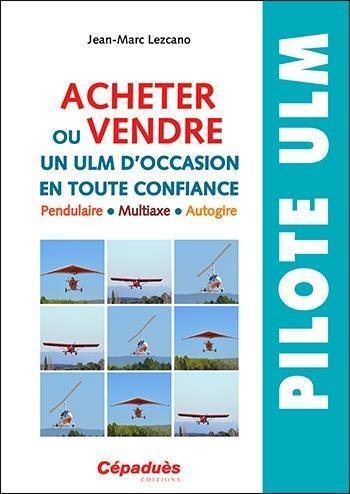
Buy or sell a used ULM with confidence
Experience shows that buying and selling a second-hand ultralight is regularly fraught with difficulties, even for people who have been working in the ultralight world for many years. In addition, the amounts involved are high.
The seller may find himself confronted with a dispute, or even a litigation procedure after the sale. The buyer may see his acquisition nailed to the ground in pure loss for various reasons. Added to these situations of good faith are the actions of less well-intentioned people: concealment, deception, bad faith or even fraud...
In other cases, fortunately the most frequent, the buyer must understand the state of the ULM he plans to acquire, the way it has been maintained, with the least possible uncertainty, to exercise his leisure in the third dimension with the best confidence. The seller will gain by transparently highlighting the advantages of a healthy and well-maintained ultralight, in the face of the buyer's inevitable mistrust.
This book was written to help develop this mutual trust when buying or selling an ultralight. Beyond basic advice, it provides a methodological framework for understanding the detailed examination of essential or useful documents, visual examinations of the powertrain and airframe, and supporting the sale with more in-depth technical examinations, before carrying out a flight test.
It can also serve as a guide to improve the capital preservation of any ultralight acquired - which will one day be resold - by encouraging the implementation of practices that will develop the confidence of the future buyer.
Sommaire
Chapitre 1. Acheter ou vendre un ULM d’occasion
Chapitre 2. Premiers conseils à l’acheteur
Chapitre 3. Examen documentaire
Chapitre 4. L’examen visuel du groupe motopropulseur
Chapitre 5. L’examen visuel de la cellule
Chapitre 6. Les examens techniques
Chapitre 7. L’essai en vol
Chapitre 8. Conseils au vendeur
Table des matières
Remerciements
Préambule
Chapitre 1. Acheter ou vendre un ULM d’occasion
Chapitre 2. Premiers conseils à l’acheteur
2.1. Augmenter sa maturité en tant qu’acheteur
2.2. Connaître les constructeurs et leur réseau
2.3. Acheter en copropriété ?
2.4. Acheter auprès d’un professionnel ou d’un particulier ?
2.5. Être certain de pouvoir stationner votre ULM
2.6. Choisir une gamme d’ULM candidats
2.7. Évaluer la crédibilité de l’offre
Chapitre 3. Examen documentaire
3.1. Les documents indispensables
3.1.1. Carte d’identification
3.1.2. Fiche d’identification
3.1.3. Déclaration d’aptitude au vol
3.1.4. Licence de station d’aéronef
3.1.5. Fiche de pesée
3.1.6. Les manuels d’utilisation et d’entretien
3.1.7. Déclaration de cession d’un ULM
3.1.8. Contrat de vente
3.2. Les informations utiles
3.2.1. Temps limites
3.2.2. Les numéros de série
3.2.3. Le carnet de route
3.2.4. Les preuves du suivi de programme d’entretien
3.3. Autres éléments en cas d’achat à l’étranger
Chapitre 4. L’examen visuel du groupe motopropulseur
4.1. Circuit « Carburant »
4.2. Circuit « Air »
4.3. Circuit « Électricité »
4.4. Circuit « Échappement »
4.5. Circuit « Refroidissement »
4.6. Circuit « Lubrification »
4.7. Circuit « Puissance »
4.7.1. Réducteur
4.7.2. Hélice
4.7.3. Silentblocs moteur
4.7.4. Support moteur
4.7.5. Système de prélancement (autogire)
Chapitre 5. L’examen visuel de la cellule
5.1. Extérieur
5.1.1. Symétrie
5.1.2. Aspect général
5.1.3. Boulonnerie
5.1.4. Voilure, empennages, gouvernes
5.1.5. Train d’atterrissage
5.1.6. Fuselage, chariot, châssis
5.2. Intérieur
5.2.1. Aspect général et intérieur de la structure
5.2.2. Lignes de commande
5.2.3. Instrumentation et équipements additionnels
Chapitre 6. Les examens techniques
6.1. Pesée
6.2. Mesure du taux de fuite des cylindres
6.3. Examen des compressions
6.4. Analyse d’huile
6.5. Examen des enregistrements éventuels
de paramètres moteur
6.6. Examen de la synchronisation des carburateurs
Chapitre 7. L’essai en vol
7.1. Mise en route et essais moteur
7.2. Décollage
7.3. Stabilité et maniabilité
7.4. Étendue du domaine de vol
7.5. Agrément à bord
7.6. Atterrissage
Chapitre 8. Conseils au vendeur
8.1. Préparer la vente
8.2. Publier des annonces
8.3. Crédibilité de l’acheteur
8.4. Contrat et paiement
Conclusion
Index
No se ha podido cargar la disponibilidad de recogida
Acheter ou vendre un ULM d'occasion en toute confiance está agotado y se enviará tan pronto como vuelva a estar disponible.

Buy or sell a used ULM with confidence
Paiement sécurisé
Vos informations de paiement sont traitées de manière sécurisée. Nous ne stockons pas les détails de votre carte de crédit et n'avons pas accès aux informations de votre carte de crédit.
