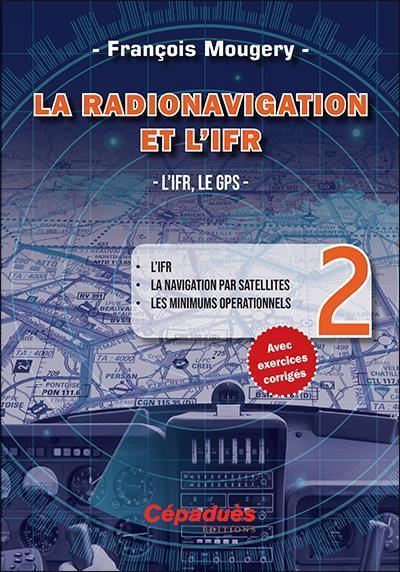
La Radionavigation et l'IFR. L'IFR, le GPS - Tome 2 - 2e Edition
2e Edition
Cet ouvrage est le deuxième d’une collection de 3 tomes consacrés à la radionavigation. Il s’adresse à ceux qui désirent améliorer leurs connaissances dans ce domaine. Il pourra également servir de référence à l’instructeur, qui y trouvera matière à illustrer son cours.
In the previous volume, we have étudié :
- mental arithmetic
- the materialization of the position in space
- the different methods of axis change
- and conventional means of radionavigation (VOR, HSI, DME, ILS, ADF, RMI, etc.).
This knowledge will now allow us to study IFR and GPS trajectories.
For most private pilots, the use of GPS often boils down to a simple " Goto ". We will see the different options, often ignored, of this function. We will introduce the notion of flight plan, a succession of branches characterized in particular by a starting point and an end point. A flight plan is very useful when the planned trajectory does not consist of a simple straight line and helps to relieve the pilot's workload. The study of the flight plan, its input and its development in flight will allow us to introduce the notions of active branch and point and self-sequencing of points.
We will study the different approaches GPS : LNAV, LNAV/VNAV and LPV. Since the EGNOS system was declared operational in 2011, GPS approach procedures have multiplied in Europe and particularly in France. Many aerodromes with a simple NDB approach now also have an LPV approach, which is a considerable step forward. Furthermore, ILS procedures are often replaced by LPV procedures at secondary aerodromes.
The most frequent errors will be explained as will the questions often asked by utilisateurs :
- When is it necessary to suspend or resume the auto-séquencement ?
- What do I do if I forget to suspend the one - ci ?
- What is the difference between the modes " OBS " and " SUSP " ?
- Is it necessary to systematically activate an approach and what is the consequence of its activation ?
- What is the difference between a " Goto " on a point in the flight plan and on a point that is not pas ?
- What happens if we delete actif in flight?
Summary
Foreword
1. THE I.F.R.
2. Satellite navigation
Conclusion
A. Correction of exercises
B. Operating minima
C. Aerodrome Traffic Integration Rules
D. End-segment concepts and RNAV point coding
Table of Contents
Impossible de charger la disponibilité pour le Service de retrait
La Radionavigation et l'IFR. L'IFR, le GPS - Tome 2 - 2e Edition est en rupture de stock et sera expédié dès qu’il sera de retour en stock.

La Radionavigation et l'IFR. L'IFR, le GPS - Tome 2 - 2e Ed...
Paiement sécurisé
Vos informations de paiement sont traitées de manière sécurisée. Nous ne stockons pas les détails de votre carte de crédit et n'avons pas accès aux informations de votre carte de crédit.